
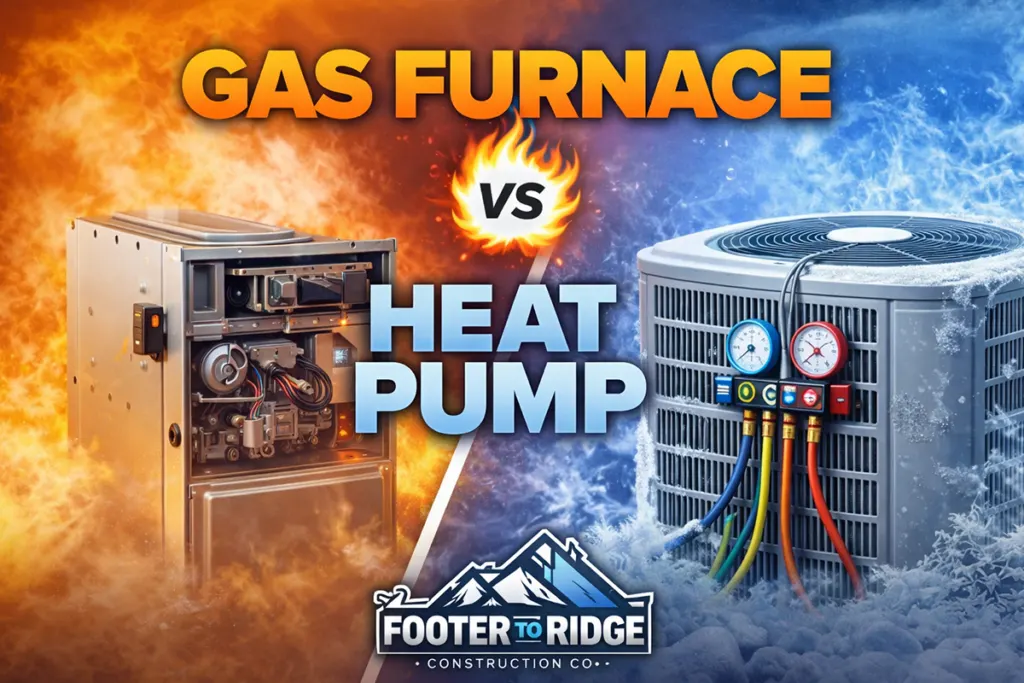
Gas Furnace vs Heat Pump: Which Is Better?
Footer to Ridge Construction Co., established in 2019 and backed by more than 40 years of construction experience, provides gas furnace and heat pump guidance throughout Wilkes County, NC.
Choosing between a gas furnace and a heat pump depends on energy costs, comfort expectations, and your home’s setup. This guide compares both systems so Wilkes County homeowners can make a confident decision.
Quick Overview
Both gas furnaces and heat pumps are common in Wilkes County homes. Gas furnaces generate heat by burning fuel, while heat pumps move heat using electricity. Each has advantages depending on climate, fuel availability, and long-term costs.
Gas Furnace vs Heat Pump Comparison
| Feature | Gas Furnace | Heat Pump |
|---|---|---|
| Heat Source | Natural gas or propane | Electric (moves heat) |
| Heating Strength | Very strong, fast heat | Moderate, steady heat |
| Cooling Capability | No (AC required) | Yes (heating & cooling) |
| Efficiency | High (up to 98% AFUE) | Very high (300%+ equivalent) |
| Cold Weather Performance | Excellent | Good (backup heat helps) |
| Operating Cost | Lower when gas is cheap | Lower in mild climates |
| Average Lifespan | 15–20 years | 12–15 years |
Pros & Cons of a Gas Furnace
Pros
- Powerful heat in cold weather
- Lower winter heating bills (gas areas)
- Long lifespan
Cons
- Requires gas line or propane tank
- No cooling without separate AC
- Higher carbon emissions
Pros & Cons of a Heat Pump
Pros
- Heating and cooling in one system
- Very energy efficient
- Lower environmental impact
Cons
- Less heat output in extreme cold
- Higher electric usage
- May require backup heat
Which Is Better for Wilkes County Homes?
In Wilkes County’s climate, both systems work well. Homes with access to natural gas often prefer furnaces for strong winter heating. Heat pumps are popular for their efficiency and all-in-one heating and cooling—especially in well-insulated homes.
Many homeowners choose a dual-fuel system (heat pump + gas furnace) for maximum efficiency.
Related HVAC Services
heating-system comparison FAQs
Which system is cheaper to run?
It depends on gas and electric rates. Gas furnaces are cheaper in colder months when gas prices are low, while heat pumps excel in mild temperatures.
Can I switch from a gas furnace to a heat pump?
Yes. Many homeowners upgrade, especially when replacing older systems.
Which system lasts longer?
Gas furnaces typically last longer, but both systems perform well with proper maintenance.
Compare the Whole System, Not Just the Equipment Name
A furnace and a heat pump create comfort in different ways. A furnace produces heat at the home, while a heat pump moves heat and also provides cooling. That difference affects utility use, equipment configuration, ductwork, electrical needs and how the system feels during operation. The better choice for a particular property depends on the house, existing equipment, available utilities and the homeowner’s priorities.
For an existing home, replacement decisions should start with what is already there. A house with a usable gas connection, compatible venting and a sound duct system presents a different project than a home with electric heat, aging ductwork or an existing heat pump. Changing system type can involve more than swapping an indoor unit, so the complete installation scope should be considered before comparing purchase prices.
Comfort, Efficiency and Cold-Weather Operation
Modern heat pumps can provide efficient heating through a large portion of the heating season while also handling summer cooling. Their supply-air temperature may feel different from the hotter air produced by a gas furnace, even when the house is maintaining the thermostat setting. Some systems use auxiliary electric heat or a dual-fuel arrangement to provide additional capacity under certain conditions.
A gas furnace delivers combustion-based heat and requires the associated fuel supply, venting, safety controls and combustion considerations. Furnace efficiency ratings help compare models, but fuel price, run time and the condition of the duct system still affect actual operating cost. No single operating-cost claim applies to every home because gas and electric rates, equipment efficiency and weather all vary.
Reasons a Heat Pump May Fit
- One system can provide both heating and cooling.
- The home already uses electric heating and cooling equipment.
- The homeowner wants to compare efficient electric heating options.
- The property does not have a convenient gas supply.
- A dual-fuel design is being considered with an existing or new furnace.
Reasons a Gas Furnace May Fit
- The property already has natural gas or another compatible fuel setup.
- The existing ductwork and venting arrangement supports the proposed equipment.
- The homeowner prefers the operating characteristics of combustion heat.
- The project is replacing an existing furnace without changing the entire system type.
- Fuel and electric costs favor the furnace option for that household.
Questions to Ask Before Choosing
Start with the equipment age, recent repairs, comfort complaints and monthly utility use. Then consider whether the duct system serves the house evenly, whether rooms have been added since the original system was installed and whether air sealing or insulation improvements are planned. New equipment cannot correct every building-side problem by itself.
Also ask what happens during a future repair. Part availability, system complexity, warranty terms, service access and the homeowner’s tolerance for backup heat or dual-fuel operation can matter as much as the headline efficiency number. A good replacement plan should be understandable after the installation, not only during the sales conversation.
When to Use the Repair or Installation Pages
If the current system has stopped working and the first goal is diagnosis, start with HVAC repair. If you are already planning new equipment, changing system type or replacing an aging system, use the installation and replacement guide. The comparison on this page is intended to help organize the decision, not replace a review of the actual home and equipment.
Additional Furnace and Heat Pump FAQs
Does a heat pump always need backup heat?
System design varies. Some heat-pump systems use electric auxiliary heat, some are paired with a furnace in a dual-fuel setup, and others are selected to meet the home’s heating load differently. The equipment and control strategy should be evaluated as a complete system.
Will changing from a furnace to a heat pump require duct changes?
Not always, but existing ducts should be evaluated for airflow, size, condition and room distribution. A different piece of equipment does not guarantee that an older duct system is automatically a good match.
Should I replace working equipment just for efficiency?
That decision depends on equipment condition, operating cost, comfort, expected ownership period and the cost of replacement. It is usually more useful to compare the full project and likely benefits than to rely on efficiency ratings alone.